Do you know all the icons on your WordPress editing menu? Read more Read more…
Social media for organic businesses and causes

On 28 February 2013, I held a social media workshop for the Soil Association.
Hence image of soil at Soil Association-certified Rush Farm.
Here are notes from my slides.
What is social media?
Web technology makes posting online easy for non-tecchies (such as I).
Spreading message via people you trust – friends, family, colleagues: it is social.
Social media allows us to be our own publishers: we are the media.
Virality
Web technology amplifies effects of word-of-mouth.
One click – a post is shared. Another click – re-shared.
Messages go viral, spreading far-and-wide.
New media changes relationships
Communications are no longer one-way.
They are based on relationships, circles of trust, word of mouth.
Recommendation is king.
The social media generation care about what their friends think – not your advert.
Join the conversation.
New skills
- Connect – be curious
- Listen and engage
- Take part
- Influence – not control.
Social media is having conversations online.
Dialogue is:
- Authentic (respectful personality shines through)
- Inclusive (jargon-free)
- Consumer-focused (not an advertisement).
Know thyself
Each time you post, you show:
- What you believe in
- What you think is important
- Your expert knowledge.
Social media gives you the opportunity to:
- Link to people you need to connect to
- Have a two way conversations
- Conduct real-time market research.
- Define and refine your brand.
#Horsemeat scandal
Whilst traditional media prefers ‘new’ news, social media saw the horsemeat scandal story run and run (pun intended).
#Horsemeat trended – one of the most-talked-about stories on Twitter.
– which the traditional press picked up on.
Radio Times reported the best Tesco, Findus and Ikea horsemeat jokes on Twitter.
Daily Mail reported “Fury at Tesco’s ill-judged Twitter joke in wake of horse meat scandal”.
(I feel a bit sorry for the hapless social media person who scheduled the “ill-judged” tweet).
Social media holds poor performance to account.
Social media continues to keep the #horsemeat scandal live and kicking (pun intended).
Organic – the opposite to horsemeat
Consumer research shows the more people know the truth about food production
– the more they choose organic.
Real stories suit social media
Big Food spends billions marketing illusions. Organic food has no need to spend budgets on pretence.
It has authenticity, naturally.
The web is based on transparency and so is organic food.
You know exactly how your food is produced and where it is from.
Tell your real story on social media. Nothing beats the real thing.
Social media democratises communications
Equal to the printing press, social media has changed the way we communicate.
No longer is the editor, the gatekeeper, guarding what is news.
We decide what is news.
Organic news outlets
Specify your news interests to Google News so it aggregates for instance ‘organic’ news stories for you.
Sign up to Soil Association daily media digest.
Follow NYR News and subscribe to GM Education.
Google news alert
Publish your own news and link to news you think is important.
Subscribe to Google news alert
to be alerted of posts publishing your company name and other key words.
Writing skills
What makes a post engaging is a matter of opinion.
What’s not a matter of opinion?
Correct spelling and reasonable grammar.
(Succint thought thanks to WordPress Traffic Dos and Don’ts).
Writing tips
- Use a spellcheck
- Edit for clarity
- Re-writing is a sign of strength not weakness
- Re-read, re-write, re-read, re-write
- Cut unnecessary words (the, that) – be concise
- Look at order – smooth? Read aloud
- Avoid jargon, and industry “in” words.
As Fran Price says: “Would your grandmother understand?”.
What are #hash-tags?
Put key word and # in the Search box in Twitter (and now Facebook)
to find the Tweets using the same #.
Create your own for conferences for instance
- Oxford Real Farming #orfc2014
- Soil Association #saconf (which trended on first day)
Further reading: What is a hashtag? (Mashable).
Right and wrong ways to Hashtag on Twitter (Medium).
Twitter basics
- Click “Retweet” (‘neath Tweet) and someone’s else’s Tweet is reposted to your followers
- If you change rewording of your Tweet, start with MT (Modified Tweet)
- Tweets to @ Twitter name are public
- Start Tweet with @ Twitter name to be seen by yours and theirs followers only
- If you want a Tweet to be seen by more than yours and their followers, add at least one character before @ Twitter name
- Direct messages (top menu third from left ) are private, and can only be sent to people who Follow you.
Twitter biography
Take your 160 characters bio seriously – it is searchable.
Use your full name and key words (key words are those used to search for what you have offer: organic, meat, farm visits).
Link to your website. Include telephone number or link to easy way to contact you.
Include call to action such as a link to sign up to email list or vote etc
Further reading: How to write a rock star Twitter bio (Mashable).
Images on Twitter
Latest: No need to click a link to see an attached image
– the Tweet itself expands. Tweets with “expanded images” increase traction.
As far as I know, only works with images first downloaded, then uploaded directly to Twitter,using .twitter.com URL.
Further reading: Make the most of images on Twitter (Buffer).
Build your audience on Twitter
Why? Build target audience for your messages. How?
Find your allies.
Express an opinion that will appeal to potential followers.
Follow others – smaller ones will follow back
Follow other people’s list of Followers.
Follow back your (loosely relevant) Followers.
Tweet – 140 characters only
Choice is shorter than Favourite.
Find shorter synonyms (different names for same word) at this thesaurus
Delete unnecessary words such as “that” and “the”
Retweet = RT
And – use + or &
Numbers for words, for instance one 1
Contractions: cannot = can’t
Strike a balance – do not talk in text-speak. Be friendly and professional: Avoid “u” instead of “you”
Tidy text with automatic link shorteners
Bit.ly is shorter than other shorteners including Tinyurl.
Bit.ly
- Shortens (shorter than tiny.url)
- Groups under same bitly link
- Search with key words
- Soil Association also uses Bitly
-
Bitly measures: for instance, 73 clicked on Soil Association’s Bitly link (organic farming saves birds, bees, wildflowers).
14 clicked on my Bitly link of the same report.
Sign up to Bit.ly with an email address.
Measuring and managing social media
-
Further reading: Apps or sites can help manage social media. They can:
- Schedule messages and tweets
- Manage multiple social networks
- Track brand mentions
- Analyse social media traffic.
-
Check out Buffer
Bristol-based Christopher Street, Bristol Editor, recommends and helps you get the most out of Hootsuite.
Marketing strategy
Include social media in your marketing strategy and identify aims such as increased sales.
Increase your target audience with:
Competitions, offers, and events (Vegetarian Week, National Butcher’s Week, Organic September).
Further reading: Ideas for Facebook and Twitter #competitions.
What IS a marketing strategy? Great article (added by me, 9 June 2014).
ROI – Return on Investment
Like PR, social media hard to measure in direct sales (and would take an extra expense to do so).
Social media is part of today’s PR budget. Investment of time will achieve increased:
- Audience
- Findability
- Contactibility
- Brand recognition
- Trust
- Expression of key messages.
<
Time
Signing up to a social media account is free.
Investment is time. To make good posts, you need time and concentration to be:
- Accurate
- Relevant
- Accessible
- Engaging.
- Ten minutes a week-day is absolute minimum for each social media account.
Allow extra time per month to check reviews on Trip Advisor, Yelp and Google Reviews.
Why Facebook?
- Gathers a lot of people in one place
- 1.19 billion active users (The Next Web) in October 2013
- Increases your site’s ranking
- “Recommendations” more valuable than key word search.
Facebook Page
Set up a Facebook Page by setting up Profile first
Facebook page is:
- Mini website
- Easily found via Google
- Easily updated
- Versatile: Add apps (Notes, Events, Photos).
Minimum Facebook activity
- Link to allies – find their Facebook page. Like it.
- Use @ to connect to them in a post
- Go to ‘Home” and Like the posts you like of your allies such as Organic UK
- Share posts you like on your Page
- Comment – it gets you extra attention!
YouTube
Post links to videos on Twitter and Facebook.
Follow your allies such as the Soil Association and Sustainable Food Trust.
Think about setting up your own channel.
Make 1-min spontaneous videos with a smart phone.
Watch Yeo Valley’s phenomenal rap.
Love it – see mine.
Image-led and easy to share images; 70% female; Food is top category; 57% discussing food
– see social media Infographic 2013.
Google +
Local shops/farms should register – it helps Google search because it ties in with Google Maps.
Google Hangouts
One-on-one, and group video chats (up to ten people).
Similar to Skype, Google hangouts uses technology to switch the focus to the person currently chatting, explains Mashable.
Stay in touch with business contacts
Minimum activity:
- Update biography and upload your/company image
- Accept invitations
- Endorse other people’s skills
- Join relevant groups (and at least Like comments you like)
- Follow company pages.
- Beyond bare minimum:Create group and publish your news from your website to your followers.
Logins and passwords
- Keep safely
- Make sure logins do not leave when employee who set up account leaves
- Use company email address
- Change annually for cyber safety
- Change to remedy spam.
Research big brands
Whether you like them or not, study the ones with clear communications and good ideas – and the cash to implement them.
Innocent’s Chain of Good or Starbucks – idea from its customers.
Finally
You are in control. If time is precious, choose ONE social media account (ie Twitter)
– and do it well.
Remember, you are in public.
Be respectful.
My boutique business, Winkler Media, helps manage people’s PR and social media needs.
Dear workshop participants
Do leave a reply in the comment box below, and a link to your website!
Katie Stewart hash tag on Twitter

Yesterday, I heard from the Guild of Food Writers by email the sad news that cookery writer, Katie Stewart, had died.
After I posted the news on Twitter, there was an outpouring from fellow food writers.
Katie Stewart’s recipes had taught many of us to cook.
Fiona Beckett, Guardian food writer suggested on Twitter having a cookery day or weekend where we cook a Katie recipe in memoriam.
Others joined in. The idea is growing in popularity.
But because the conversation is taking place on Twitter, we only have 140 characters for each message we post.
And it’s getting hard to fit the growing number of food writers in one Tweet, and write anything meaningful, yet at the same time include everyone in the message.
Enter the hash tag!
If we use #katiestewart in our Katie-related Tweets, then we can search for the topic, and hopefully be reunited with our fellow memorial cooks (and interested observers) swiftly.
What do you think, @food_writer, @misspearlbarley, @guildfoodwriter, @fussfreehelen, @lesleymackay, @catlilycooks, @ThaneCooks, @lickedspoon, @foodjournalist @britishfood?
Press Release Dos and Don’ts
My knowledge is based on writing press releases for 20 years as a publicist for Ekome African Dance Company, author Rosalyn Chissick and many many more.
Then, as Soil Association magazine editor for eight years, I was sent press releases. So I got to see press releases from both sides.
What is a press release? It is content to promote something. Instead of paying for an advert, you are hoping your press release is so newsworthy that an editor will use it as editorial (copy) in a publication, or as a feature for radio or TV.
Press Release Dos and Don’ts
1. Think about your email subject line. Editors are crazy-busy. Will they even open your email? Give a date so editor knows how urgent it is.
2. Keep it short. Remember your crazy-busy editor. The most important information comes first. Five short paragraphs are enough to tell the story.
3. Start the press release: For immediate release (or: embargoed until…). That way the editor knows immediately when the content of the press release can be published by the editor.
4. Do give contact information (name, mobile) at the top of the press release and say who it is from. Please make it as easy as possible for your busy editor.
5. The heading and/or sub-heading needs to tell editor why it is news and relevant to her/his audience – is it first/new/final/famous/biggest/local?
6. Your five most important paragraphs concern:
When? – Date, time
Where? – Location
Who? – Correct names and titles of main people and/or event
What? – What is this all about and why is it important?
How? – How do I get involved/buy tickets
7. Do send a press release before an event (not after).
8. Don’t whinge or exaggerate. No hyperbole. Give the facts. Imagine your press release in print.
9. Use a quote from a key player to bring press release alive. Quotes are the only places you can use adjectives and express emotion.
10. Give background detail as numbered Editor’s Notes after the main 5 paragraphs.
11. Editor’s Notes can include links to company or cause’s website, Facebook and Twitter – using Facebook and Twitter (or other social media channels) creates live engagement. It’s a two-way conversation.
12. Don’t send the press release as an attachment, which are rarely opened. However, a good strong image will encourage an editor to use it. Think about sending a low-res image to start with.
13. Do think about using Mail Chimp – free email manager to keep press releases and press contacts in one place. I myself now favour simple press releases as they are more likely to be noticed.
14. Do read your press release aloud. Does it say what you want to say? Have you given the most important information, first? Any repetition is a no-no.
15. Do ask someone else to read it. Ask your reader: is there anything you do not understand? If so, what? Don’t get annoyed by the answer. Responsibility for successful communications lies with the communicator.
16. Do make sure main people involved are happy with press release and sign it off before you send it.
17. Check name of current editor – only send relevant and timely press releases.
18. Do ring after you have sent press release to ask if press release has arrived and if it is of interest. This is an appropriate way to form or develop a relationship with the news/features editor.
19. Don’t leave an answer machine message asking the editor to ring you back – it is unlikely they will. (If you have to, speak your telephone number clearly and do not gabble. I lost count of the times, people gave the number too fast to get it down the first time.).
20. Do create a Google news alert for your news item to track any online publication.
Well, that’s not exhaustive. But it is a start.
What else would you like to know?
Wikipedia is 10 – Jimmy Wales talks

Do you use Wikipedia?
That was the first question Jimmy Wales asked the 300 + audience at the Victoria Rooms last Thursday in Bristol.
The auditorium was a forest of hands.
How many of you have edited Wikipedia, he asked?
A good third put up their hands.
The founder of Wikipedia gave his only UK public talk to celebrate the online encyclopaedia’s 10th anniversary.
A modern legend, Jimmy Wales was a witty, warm, engaging and informative speaker.
- Judge for yourself from the webcast.
- The talk’s genesis in November is a testament to digital Bristol including Bristol-based Steve Virgin, board director at Wikimedia UK, the UK chapter of the charity supporting Wikipedia – £5 to join.
- Mike’s post at Socially Mobile sums up main points of the talk.
As a female, I was struck by the stat: 87% of Wikimedia editors are male.
Jimmy Wales made clear Wikipedia wants to rectify the male mostly young, tecchie, PhD bias.
Sounds like an invitation.
The Wikipedia credo: “Free knowledge for all” inspires me.
And I do like to bring balance to bias with my own bias.
After the talk, Mike and I stumbled on a group – male – surrounding Jimmy Wales backstage in the theatre bar. My opportunity to bring balance had come sooner than expected.
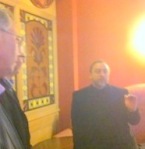

Mike asked Jimmy Wales about Quora – the new in-place for asking questions and getting intelligent answers. Did he see Wikipedia joining forces?
Jimmy Wales said no, but his lengthy answer suggested Quora was on his mind too.
I asked the final question:
“Did you use an encyclopaedia as a child?”
He said as a kid, he loved The World Book given by his mother. The encyclopaedia provided stickers to update events such as the first moon landing.
While researching how to reference this story, I came across Pulitzer-prize winning, Stacy Schiff’s piece on Wikipedia by , .
She writes: “It can still seem as though the user who spends the most time on the site – or who yells the loudest – wins.”
Then we all ended up outside the Victoria Rooms while Jimmy Wales waited for his taxi and Mike took the picture above.
Jimmy Wales has a charismatic rock star aura, and like Wikipedia, is beautifully human and flawed, but aims to be democratic.
I can’t argue with that. Can you?
5.2.11 Edited for style after preferring WP10’s opening paragraph which gave me fresh eyes so I tweaked the rest. WP10’s version cut out the refs to Bristol – now in bullet points – and ended the opening paragraph with the line about Jimmy being an engaging speaker. I also cut out my picture of the Victoria Rooms balcony.
Narrative thread with Andrew Davies
Here is Andrew Davies at the Animations Encounters festival in Bristol today on Narrative thread.
TV writer and screenplay author, Andrew Davies, says: Narrative nowadays is fashionable and so is the word. It has even spread to politics and advertising: “We need a coherent narrative”, as they say.
He says: “I briefly argue that all narrative is adaptation.”
Every time a book is read it is adapted uniquely by the reader.
Indeed, he asks: Is there a such a thing as pure experience?
Andrew Davies offers detailed examples of “inter-textuality” which he kindly translates as nicking things from other people’s work.
He starts with his successful TV series: A Very Particular Practice.
“I was trying to make something unique,” including a unique mix.
This mix included the idea of the campus novel by David Lodge, and typical archetypes from medical dramas, but subverted i.e. the young doc was “emotionally fucked-up”, and not dashing.
The characters all had a “narrative of illness”, he says. Bob Buzzard, “my favourite character to write, a Thatcherite who saw the human body as a messy, inferior version of a machine,” says Andrew Davies. “He just hated people.”
He showed a clip from the TV show, A Very Peculiar Practice.
And then to Davies’ adaptation of Pride and Prejudice.
His producer and he decided Jane Austen’s novel was to do with “sex and money”.
“It’s the ‘selfish gene’ inside Darcy’s breeches…” that is driving the plot, he says. Wanting to stress the body not the mind, he devised scenes where people had had a bath etc.
Not to mention, of course, the famous scene of Darcy unbuttoning his shirt ready for a dip. (But hey, he swum clothed as the clip reminds us.)
Davies said he never conceived it as a sexy scene but rather to emphasise Darcy’s physicality and relief being back in his country pad after the artificiality of town. He wanted Colin Firth stark naked but the actor objected.
(Actor would not have got away with this if he’d been actress. Ed).
Andrew Davies’ tip: take something that has already worked, such as Shakespeare, grabbing the bits you like and recasting it as modern drama.
Especially suited for those who find inventing from scratch does not come easily, he says.
“Don’t be ashamed because ‘they’ all did it too.” Including, of course, Shakespeare.
As Davies did with his Othello, recasting him as the UK’s first black police commissioner. Davies also wanted to give Iago clearer and different motivations. So Davies recast his Iago (Jago) as superior in rank to Othello, who never saw himself as racist until Othello was promoted above him…
The Chatterly Affair was about the obscenity trial surrounding DH Lawrence’s book. Davies laughs when he tells of the praise he got from the producer for his idea of two on the jury having an affair, echoing Lawrence’s novel.
Questions from the floor reveal: Davies says he does very little research before writing and checks his facts later – “some writers get bogged down in research.”
“Just clicking with someone powerful in the business,” says Davies is what led to success. Before that, he kept getting “discovered then dropped and forgotten about for five years”.
Davies: “Always try to have something out there before something comes thudding back.”
How do you sift through huge amount of material such Vanity Fair? someone asked from the audience. He boiled down the story to bad girl, good girl, and made sure every scene related to that theme.
Another tip: ensure the resolution is in the hand of the protagonist, he says quoting screenwriter, Robert McKee.
Davies’ new adaptation, South Riding, is set in Yorkshire in the 1930s – a time of recession and poverty, in which he is trying to make “exquisite links” with the present.
He was going to do “another huge Trollope” but BBC has changed its mind, although “they will change it again,” he reckons.
The hardest bit about writing, he says, is the first page, and the usual self-doubt: “I can’t do this.”
Someone else asks for tips for getting noticed.
Davies: “Just write wonderful things.”
As his agent would often tell him:
“Talent always wins through in the end.”
Do bloggers need a union?
I am a union person.
I have belonged to the National Union of Journalists (NUJ) for as long as I’ve been a freelance journalist.
The NUJ has got me out of a few scrapes over the past 20 years. Helped me claw back fee due from a national newspaper. Supported me when a publication dissed my rep.
I do not begrudge my union dues because they insure me for future grievances and in the meantime help some other poor bugger.
I know my history – without unions, workers would still be working a 12-hour day. (As many still do).
On the 22 and 23 October 2010, my local branch, the Bristol NUJ, asked: What’s the blogging story?
Research conducted for the union shows there are 20,000 workers in digital new media in the Bristol area.
Note: the term blogger here includes those creating online content.
As a union gal already paying union fees for my printed work, I would LOVE my online work to be covered too.
Several made the point that bloggers certainly help journalists: with their original and brave research, said Iqbal Tamimi; and with technical expertise, said Tomas Rawlings.
From a union’s point-of-view, thousands of unregulated online workers must be a dream. Both the NUJ’s fortune and its collective bargaining power would swell magnificently.
Mind you, some journalists are nervous of bloggers – many of whom work for nothing. So bloggers could be seen as undermining the profession.
Leaving that underlying tension aside, I wondered as a blogger whether union membership – being accredited by a professional body – might give visitors more confidence in a site.
Visitors could clearly see I subscribe to the NUJ Code of Conduct (although there is nothing stopping any writer adhering to it, I found out).
However – said the devil’s advocate in my mind – is not the point of today’s web that a blog is authenticated by its comments and the transparency of the blogger?
And HOW would the NUJ assess who is a digital worker, especially if he/she is an unpaid blogger?
(There is a precedent for a blogger becoming an NUJ member.)
Bloggers are a notoriously independent breed. Does belonging to a union undermine that spirit?
In response, Sarah Ditum pointed out the days of “happy anarchy on the web” may be numbered – digital workers would be wise to have union support, including access to legal training.
As you can see, this fascinating topic raises a host of questions.
Here are a few more.
Bloggers, can you think of situations where you might have welcomed union support? Even to combat the isolation of being freelance?
Or is a union anathema to bloggers?
Do bloggers need a union?
What do you think?
A gap in Gap’s thinking

News that Gap has withdrawn its new logo following an outcry on its Facebook page is a fascinating case study on a) the power of Facebook to create an online community 2) the idiocy of ignoring it.
Hello? What is the point of having a Facebook page if you don’t engage with your fans?
The funny thing is that – as this astute blogger points out – Gap exchanged its TV budget (in 2009) for web and social media.
The whole point of having a social media presence is to invite interaction.
And to…er… interact.
As, rather belatedly, Marka Hansen, president of Gap Brand North America, has realised:
“We’ve been listening to and watching all of the comments this past week,” she said in a statement. According to the Independent, Gap “did not go about this in the right way” and missed the “opportunity to engage with the online community.”
I had my own Gap moment on Monday.
The Gap store in London trumpeted a “60% sale.”
But my feet just kept on walking to my favourite charity shop a few streets down.
Therein – as a reward for eschewing sale signs, I fancy – I found this darling cardigan from which I am deriving, in a time of stress, inordinate pleasure thanks to its colour, cosiness and sheer bargain-huntedness.

 Writing on the Web